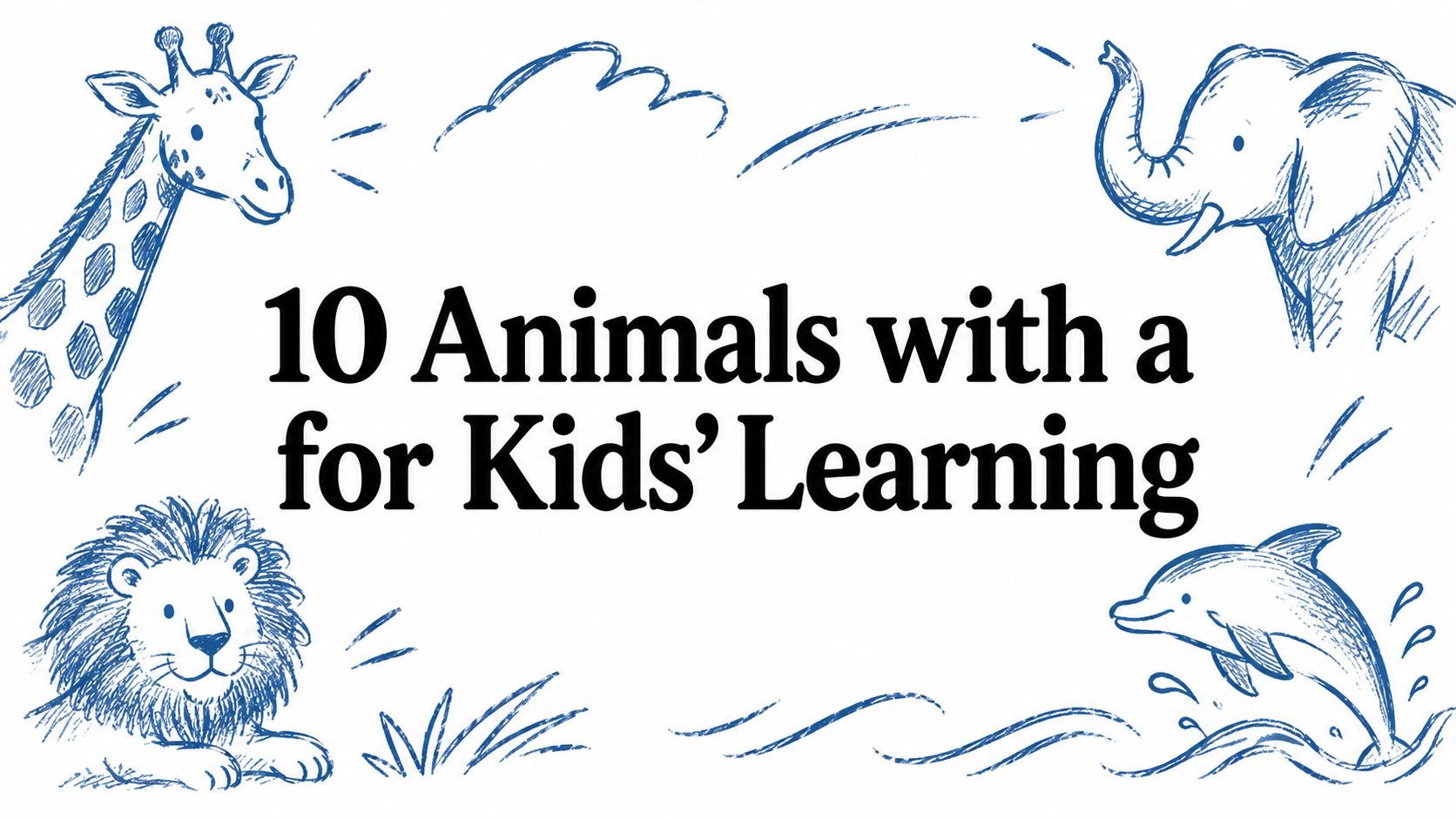
Have you ever searched for “animals with a” and wondered whether you were supposed to find animals that start with A, animals that contain the letter A, or both? That little gap in the phrase is useful for learning, because it turns a simple search into a sorting game. You can compare names, sounds, habitats, and traits while building vocabulary at the same time.
This list keeps the focus on kid-friendly animal learning. You'll find ten visually distinct animals, short fact-based profiles, memorable traits, and simple classroom prompts for drawing, sorting, researching, and discussing. The examples include ants, alpacas, axolotls, and albatrosses, plus a few comparison animals chosen because they help children remember bigger ideas like teamwork, adaptation, and communication.
1. Ants
Ants show how teamwork in nature can turn many small efforts into one organized result. A single ant may seem easy to overlook, while a colony reveals workers sharing tasks, following paths, and responding to the group's needs. This makes ants a useful classroom example of cooperation, planning, and different group roles.
Start with a simple drawing activity. Ask children to draw one ant, then add a line of ants carrying food together. Have them label the antennae, legs, and body segments. The comparison helps children see that ants often solve problems as a group rather than working alone. 1chat can help teachers turn the activity into discussion questions, sorting games, or short writing prompts.
Learning idea: Compare an ant colony with a class project. Each student may have a different job, but everyone works toward one shared goal.
Real-world behaviors make the lesson memorable. Leaf-cutter ants carry leaves underground and use them to grow food in fungal gardens. During floods, fire ants can join together to form floating rafts. These examples show how an animal's small size does not prevent creative solutions to difficult conditions.
- Draw and label: Identify the antennae, legs, and body segments.
- Sort by behavior: Place examples under “works alone” or “works together.”
- Discuss problem-solving: Ask how the colony shares work and responds to danger.
2. Alpacas
Alpacas are calm-looking animals that children often find friendly right away. Their soft appearance and gentle behavior make them useful for teaching approachability, especially when you want a lesson to feel welcoming instead of intimidating. An alpaca can help a child think, “This animal looks easy to learn about.”
That makes alpacas a strong choice for family learning time. They are often used in educational farm visits, where children can observe body language, hear vocal sounds, and notice how animals communicate without words. In a classroom, that opens a conversation about how people also show feelings through posture, facial expression, and tone.
A good activity is to ask children to list three words that describe an alpaca, then compare those words with how they might describe a shy classmate or a helpful friend. The connection builds empathy without turning the lesson into a lecture. It also gives teachers a natural bridge into social-emotional learning.
Practical rule: When a child struggles to explain an animal, start with visible traits first, like fluffiness, size, or facial expression.
Parents can also use alpacas as a “gentle start” animal when introducing younger children to wildlife topics. Instead of beginning with a scary or unfamiliar species, they can begin with something soft, calm, and easy to describe.
3. Dolphins
Dolphins are a strong animal for teaching smart problem-solving. Children usually know they live in the ocean, but they may not realize how social they are. Dolphins move in groups called pods, and that makes them a helpful example of how communication can support cooperation.
A classroom teacher can ask students to imagine a dolphin helping its pod find food or stay together in open water. That discussion naturally leads to the idea that animals can use sound, movement, and memory to work as a team. It also gives children a way to compare animal communication with human communication in schools, sports, and families.
One useful learning task is to have children list what a dolphin might need to survive, then rank those needs by importance. The exercise builds vocabulary while encouraging reasoning. It also helps children understand that intelligence is not just about reading or speaking, it can also mean sensing, remembering, and reacting well.
You can extend the lesson by asking students to draw a pod and show how the dolphins stay close together. That activity turns an abstract idea into a visual story. If you want, it also pairs well with a short research task in 1chat blog ideas and guidance, especially for older students who are practicing how to ask better questions.
4. Owls
Owls are one of the easiest animals to connect with knowledge and quiet attention. Many children already link owls with wisdom, so teachers can use that familiar idea to introduce reading, listening, and careful observation. The owl becomes a symbol for looking closely before answering.
A lesson can begin with a simple question. Why would an owl be a good animal for nighttime learning? That lets children talk about how owls notice things in darker places that other animals may miss. It also gives parents a chance to discuss the value of patience, especially when homework feels hard.
Owls are useful in school settings because they match the feeling of research. Students often need to listen, compare clues, and check details before they reach a conclusion. That is exactly the kind of thinking an owl suggests. It's also a nice way to introduce note-taking, proofreading, and careful reading.
An owl works best as a class mascot when children need to remember that good answers often come from careful looking, not fast guessing.
A fun activity is to ask students to write three questions they still have after reading a passage, then “fly like an owl” by returning to the text to search for answers. That keeps the tone playful while building real study habits.
The image below can be used to spark a short discussion about books, learning, and observation.

5. Bees
How can a tiny bee help children understand a whole living system? Bees show productive teamwork: each worker gathers resources, supports the colony, and helps flowering plants reproduce. Their actions connect one small job with a wider result, like one classroom role contributing to a shared project.
Children often start with honey. Teachers can extend that familiar idea by introducing pollination, the transfer of pollen between flowers. Bees also communicate and divide responsibilities inside the hive. Students can compare this pattern with a group assignment in which some classmates write, others draw, and another group presents.
A paper-flower activity makes the process visible. Give children several flowers and a cotton swab or small paper “bee,” then ask them to trace how pollen could travel from one flower to another. The paths create a simple map for discussing movement, signals, and cause and effect. Classroom prompts and summaries can help organize the group task.
The image below can anchor a discussion about patterns, motion, and signals.

Children can compare bees with ants. Both cooperate within colonies, while bees also support flowering plants through pollination. Ask students to draw two overlapping circles, label the shared teamwork traits, and add what makes bee work different. This turns an animal name into a memorable science and discussion activity.
6. Axolotls
Axolotls are one of the most memorable animals for teaching adaptation and regeneration. Children often remember them because they look unusual, with frilly external gills and a face that seems almost smiling. That visual distinctiveness makes the axolotl easy to sketch and even easier to discuss.
A great classroom prompt is to ask, “What would it mean to grow back a lost body part?” That question leads students into the idea that axolotls can regenerate, which gives teachers a natural doorway into biology and resilience. It also gives families a chance to talk about how learning sometimes works the same way, with improvement happening over time.
Because axolotls need the right environment to thrive, they also help children understand that living things depend on conditions around them. That's a useful lesson for gardens, pet care, and conservation. It teaches responsibility without making the conversation too heavy.
Discussion starter: Ask children why a creature with special abilities might still need protection from changes in its environment.
For older children, axolotls can support a “repair and rebuild” lesson. A student can identify a topic they don't understand yet, then break it into smaller parts and rebuild their understanding step by step. That makes the axolotl a helpful symbol for revision, not just for science facts.
7. Arctic Foxes
Arctic foxes are excellent for teaching survival through flexibility. They live in harsh places, so children can learn that animals do not all survive the same way. Some rely on speed, others on camouflage, and Arctic foxes depend on changing conditions and resourcefulness.
A child-friendly way to introduce them is to ask how a coat can help an animal. The Arctic fox changes fur color with the seasons, which is an easy fact for students to remember because it connects behavior with environment. That single trait opens the door to bigger ideas about adaptation, weather, and shelter.
Teachers can also use the Arctic fox to talk about strategy. Foxes may hunt in different ways depending on what's available, and that makes them a strong example of choosing the right tool for the job. It is a good reminder that good problem-solving is often about flexibility, not stubbornness.
A drawing activity works especially well here. Have children sketch the same fox in two settings, one snowy and one less snowy, then describe what changes and what stays the same. That supports observation, comparison, and seasonal vocabulary in one exercise.
Arctic foxes are also useful for linking animal learning to climate conversations. Children can understand that when environments change, animals may need to change too. That keeps the topic grounded in real life instead of staying abstract.
8. Elephants
Elephants are powerful symbols of memory, care, and leadership. Children usually notice their size first, but the more interesting lesson is that elephants live in social groups and remember important places and relationships. That makes them ideal for talking about experience and learning over time.
A teacher can ask children why remembering a water source would matter to an elephant family. That simple question can lead to conversations about drought, travel, and helping younger animals learn from older ones. It also connects neatly to how children learn from parents, grandparents, and teachers.
Elephants are often associated with empathy because they show strong social bonds. That makes them useful for lessons about kindness and community. A child can understand that strength is not just about size, it can also mean protecting others and sharing knowledge.
The image below can be used to start a writing exercise about memory and maps.

1chat research tools can support this kind of lesson by helping older students gather notes, organize ideas, and compare sources without losing track of what they've already learned. That makes the elephant a useful symbol for building a knowledge base over time.
9. Armadillos
Armadillos are perfect for teaching protection and careful exploration. Their armored shells make them stand out immediately, and that strong visual detail helps children remember the animal. They also dig, which gives teachers a simple way to connect the animal to soil, burrows, and hidden habitats.
A good discussion question is, “Why would an animal need armor?” Children can answer with everyday ideas like safety, defense, and staying close to the ground. That makes the concept easy to understand without losing scientific value. It also allows a teacher to compare the armadillo's shell with helmets, knee pads, or seat belts.
Armadillos are a useful example for showing that research should be thorough. They investigate the ground with their snouts and claws, which makes them a fun symbol for close observation. A student can think of an armadillo when learning how to read carefully, check details, and avoid rushing.
A classroom activity could ask children to “dig for clues” in a text. Each time they find an important detail, they write it on a paper burrow map. That turns reading into a physical, memorable game.
Armadillos also work well in conversations about privacy and protection in digital spaces. They remind older students that careful tools matter when handling sensitive information, especially in school and small business settings.
10. Albatrosses
Albatrosses are excellent for teaching distance, endurance, and partnership. Children often find them interesting because they can travel far across open ocean and still find their way effectively. That gives teachers a strong way to talk about movement, direction, and staying on course.
The albatross also stands out because it forms long-term pair bonds. That fact can help children understand commitment in nature, not just in people. It becomes a nice example of how relationships can support survival over time.
A classroom prompt can ask children to imagine what it would feel like to cross a huge space with no road signs. That question leads into the idea that some animals use wind, memory, and instinct to travel efficiently. It also gives students a chance to compare ocean navigation with map reading or classroom directions.
For a simple activity, have children draw an albatross gliding above waves and label what helps it move with less effort. They can then connect the bird's motion to a real-life example of working smarter, not harder. That makes the lesson useful for science, writing, and even teamwork discussions.
Classroom connection: An albatross can stand for steady effort, especially when a long project needs patience instead of speed.
10 A Animals: Comparative Traits
| Item | 🔄 Implementation complexity | ⚡ Resource requirements | 📊 Expected outcomes | 💡 Ideal use cases | ⭐ Key advantages |
| Ants - Master Collaborators & Efficiency Experts | Moderate, decentralized coordination and task routing required | Low per agent; scales with team size and orchestration tools | High productivity and parallel task completion | Project management, content teams, research departments | ⭐ Efficient resource allocation; scalable parallelization |
| Alpacas - Calm, Approachable, and Friendly Communicators | Low, simple, user-friendly interfaces and clear UX design | Low, minimal onboarding; emphasis on approachable design | High user engagement and accessibility for non-technical users | Families, students, non-technical audiences | ⭐ Approachable UX; low barrier to adoption |
| Dolphins - Intelligent Problem-Solvers & Social Communicators | High, coordinates multiple advanced models and complex workflows | High, compute and integration for multi-LLM collaboration | Deep, creative problem solving and adaptive solutions | Research, complex problem-solving, cross-disciplinary projects | ⭐ High-quality insights; strong collaborative reasoning |
| Owls - Knowledge Seekers & Night-Vision Experts | Moderate, tools for deep analysis and targeted retrieval | Moderate, focused data sources and analysis capabilities | Thorough, detail-oriented results and discovery of overlooked info | College students, researchers, proofreading and analysis | ⭐ Precision and depth; excels at uncovering hidden details |
| Bees - Productive Hive Workers & Efficient Communicators | Moderate, requires robust coordination and task division | Moderate, collaboration tooling and communication channels | Very high throughput and consistent output across teams | Small business operations, content production, project execution | ⭐ Exceptional collective productivity; organized workflows |
| Axolotls - Regenerative Learners & Adaptive Organisms | Moderate, supports iterative learning and continuous improvement | Moderate, stable environment/configuration and iterative data | Incremental knowledge growth and ability to recover from gaps | Students, lifelong learners, academic support programs | ⭐ Resilience and iterative learning; rebuilds understanding over time |
| Arctic Foxes - Adaptive Survivors & Multi-Strategy Problem Solvers | Moderate, enables switching strategies and model selection | Low–Moderate, flexible toolset and multiple model options | Adaptive, context-sensitive solutions across varied tasks | Flexible problem-solving, adaptive learning, multi-strategy projects | ⭐ Versatility; effective use of multiple approaches |
| Elephants - Long-Memory Knowledge Keepers & Emotional Intelligence Leaders | Low–Moderate, emphasis on long-term documentation and governance | High, storage, knowledge bases, and ongoing maintenance | Reliable institutional memory and consistent guidance over time | Education, research, team leadership, knowledge management | ⭐ Strong long-term memory and mentorship; knowledge retention |
| Armadillos - Protected Specialists & Thorough Researchers | Low, privacy-first design with secure workflows | Moderate, security measures and privacy controls required | Secure, methodical research with protected data handling | Privacy-sensitive research, confidential business work | ⭐ Privacy and thoroughness; protected exploration of sensitive data |
| Albatrosses - Long-Distance Communicators & Energy-Efficient Travelers | Low, supports asynchronous workflows and remote coordination | Low, optimized for efficient, low-overhead collaboration | Sustained long-distance collaboration and energy-efficient output | Remote teams, distributed organizations, long-term projects | ⭐ Energy-efficient communication; reliable long-distance coordination |
Turn Animal Names Into Learning Moments
The easiest way to use animals with a in the classroom is to group them by big ideas. Ants and bees teach teamwork, because both animals show how shared work can create a larger result. Alpacas and dolphins are strong choices for communication, since one helps children think about gentleness and the other helps them think about social intelligence.
For adaptation, axolotls and Arctic foxes make a strong pair. One shows regeneration and the need for the right environment, while the other shows seasonal flexibility and survival in harsh conditions. For knowledge and memory, owls and elephants work especially well, because they both suggest careful observation, long-term learning, and the value of paying attention.
A practical classroom routine is easy to build from there. Ask each child to choose one animal, draw it, and explain its standout trait in one or two sentences. Then ask them to connect that trait to a school or family activity, like group work, listening, studying, adapting to change, or helping someone remember something important.
Parents and teachers can also use 1chat to generate age-appropriate questions, analyze PDF worksheets, or create AI images that support the lesson. If you want a more visual approach, Wideo's guide to classroom animation is a useful companion for turning animal facts into short learning scenes.
When children see that an unfinished search phrase can become a full lesson, they start to treat language as a tool for discovery. That's the core value of animals with a; it's not just a list, it's a doorway into observation, vocabulary, drawing, and thoughtful discussion.